1.2.1 Systems Software
Interrupts and Interrupt Service Routines (ISR)
Interrupts let the CPU pause its current task to respond quickly to important events. Interrupt Service Routines (ISRs) handle those events, then return control so normal fetch-decode-execute processing can continue.
Activity 1: Match Interrupt Type to Description
Match each real-world example to its interrupt type, then press Check answers.
Key terms from the task
- Arithmetic overflow: A calculation produces a value too large/small for the register size.
- Buffer: Temporary memory used to hold data while it is moved between components.
- Timer interrupt: A signal generated at time intervals so the CPU can run scheduled checks or tasks.
Activity 2: ISR Sequence Ordering
When an interrupt occurs, the processor preserves its current state, runs an Interrupt Service Routine, and then restores state to continue normal execution. Understanding this sequence is key to explaining how operating systems manage urgent events efficiently.
Place steps in a valid top-to-bottom order. You do not need to use every available card.
Available steps
Your sequence
Activity 3: Interrupting an Interrupt
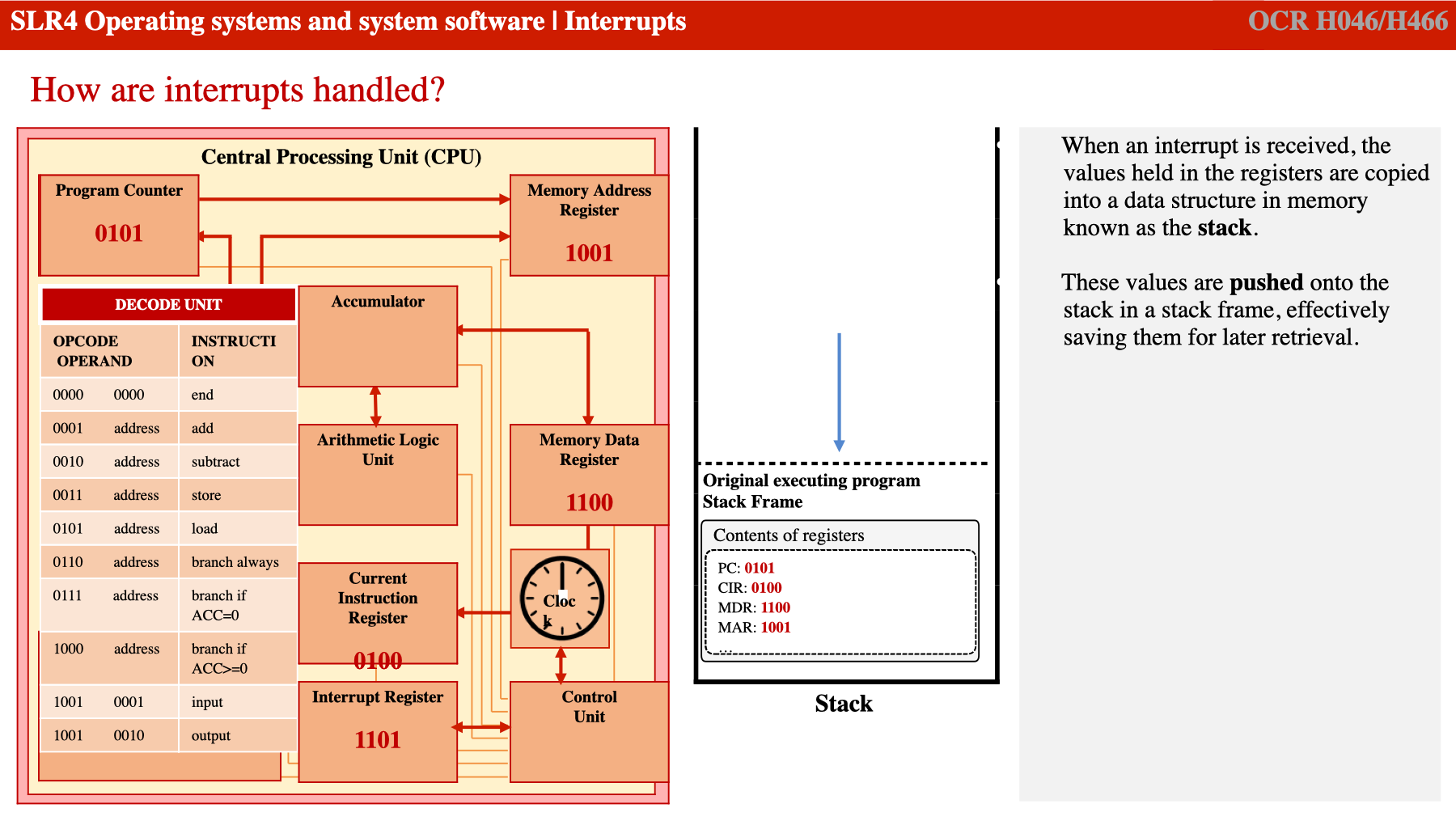
Use the slide graphic to model what happens during an interrupt. First drag register values into the stack frame (push). Then, once the interrupt is complete, drag them back into the CPU registers (pop).
Phase 1: Push register values from CPU registers into the stack frame.
CPU Registers
Stack Frame
Activity 4: Exam Question Practice
Answer the OCR-style interrupt questions below. Then check your response against key marking points.
i. One example of an interrupt would be removing an external hard disk drive from a computer.
State why this would need to interrupt the current fetch-decode-execute cycle of the CPU. [1]
ii. Interrupt Service Handlers make use of a stack data structure.
Describe how a stack is used when handling interrupts. [2]